
As a professional supply chain management company in the international home textile trade, we closely monitor shifts in market demand and manufacturing technologies. This comprehensive report provides a data-driven analysis of the Ruched Faux Fur Blanket market in 2026. Below, we highlight emerging supply chain challenges, production variations, and effective quality control solutions for global buyers and brand managers.
The global marketplace for the ruched faux fur blanket is undergoing a structural transformation characterized by the following changes:
Order Fragmentation and Color Diversification: A major trend in 2026 is the rapid entry of small-batch brands and boutique buyers. These clients enter the market with smaller initial order quantities (MOQs) but require highly diversified color palettes. Google search data and website traffic metrics show a large influx of newly registered brand names launching ruched faux fur blanket collections.
Product Line Differentiation: To stay competitive, leading Tier-1 brands are shifting their product development focus toward high-end design differentiation. This includes the development of multicolor stripes, complex geometric patterns, and reversible dual-tone aesthetics where the front and back sides feature different colors.
Pricing Pressure vs. Quality Consistency: Due to intense price competition from low-cost, small-batch sellers, many volume-driven brands have reduced their retail prices. However, established brands continue to protect their market share not by cutting prices, but by ensuring strict fabric consistency and clean, precise manufacturing details.
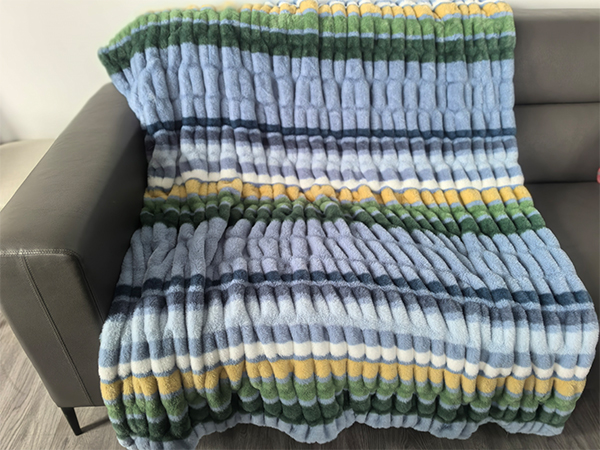
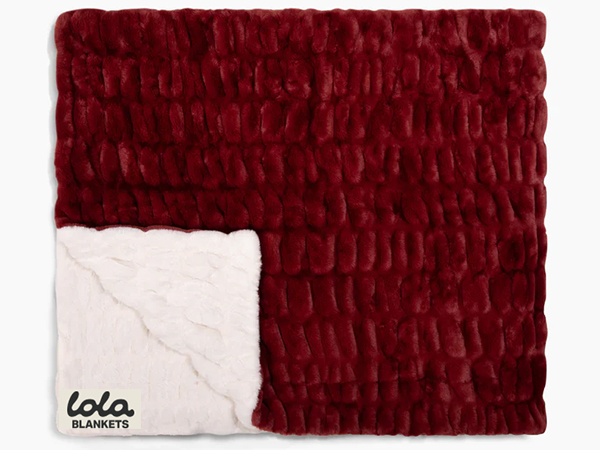
To adapt to these changes in consumer and brand demand, the textile production sector in manufacturing hubs has updated its technology and capacity:
Flexible Production Capacity vs. Lead Time Volatility: To handle fragmented, small-batch orders, weaved-fabric mills have significantly increased the number of machines dedicated to stretch faux rabbit fur production. Standard fabric weights are sometimes manufactured in advance and held in stock to allow for quick turnarounds. However, total industry lead times remain highly volatile. Depending on the factory’s current order book and scheduling, delivery times can range from 20 days to 2 full months.
Quality Consistency Risks: Because the raw material cost of spandex faux rabbit fur is relatively high, factories historically maintained very strict quality control during the early stages of product adoption. However, as finishing processes have matured and mass production volumes have grown, some mills have relaxed their internal inspection frequencies for finishing effects, fabric width, and weight, creating unexpected quality variations in final products.
Fabric Width Capabilities: Driven by the increasing global demand for oversized bedding products, manufacturing width limits have evolved. Before 2024, technical limitations in finishing machinery restricted the maximum usable fabric width to approximately 80 inches (2 meters). Today, due to market pressure and equipment upgrades, advanced facilities can successfully achieve widths of up to 100 inches (2.6 meters).
When sourcing spandex faux fur blankets, overseas sourcing agents and buyers frequently encounter four primary technical issues during mass production:
In commercial textile dyeing, minor color lot variations (dye lot deviations or vat differences) are normal. However, bulk production often suffers from more severe variations in fabric style, hand-feel, weight, and dimensions:
Coarse Texture and Hand-Feel: When the finished blanket surface feels rough or lacks a smooth fur texture, the issue typically stems from two causes: either the factory used low-quality chemical auxiliaries during dyeing, or they skipped critical post-finishing steps. This happens due to a lack of technical experience or an intentional choice to reduce production costs.
Dimensional and Width Variations: Discrepancies in fabric width and shrinkage occur because different dyeing and finishing facilities apply inconsistent tension and temperatures during the heat-setting process.
Weight Deficiencies: Sub-standard fabric weight usually happens for two reasons: either the factory cut the fabric to incorrect dimensions, or the base fabric itself did not reach the required weight during the initial weaving process.
The signature 3D bubble effect or ruched texture of the blanket depends entirely on precise temperature control during processing. Spandex materials lose their elasticity permanently when exposed to excessive heat, which leaves the final product looking flat, thin, and without its characteristic texture.
Furthermore, if the first batch of bulk fabric fails to meet color or style standards, factories sometimes attempt to re-dye and re-finish the entire batch. Subjecting the fabric to a second high-temperature thermal process completely destroys the spandex fibers, ensuring that the 3D ruched effect is ruined.
Applying a 10cm perimeter topstitch along all four edges creates a strong border that securely locks the fabric layers together. However, some brands prefer a completely clean, minimalist aesthetic and choose a non-topstitched edge (often called a knife-edge seam).
Without the reinforcement of a perimeter topstitch, the fabric layers can easily experience seam slippage. This causes the edge stitching to break and unravel rapidly during everyday consumer use and standard machine washing cycles.

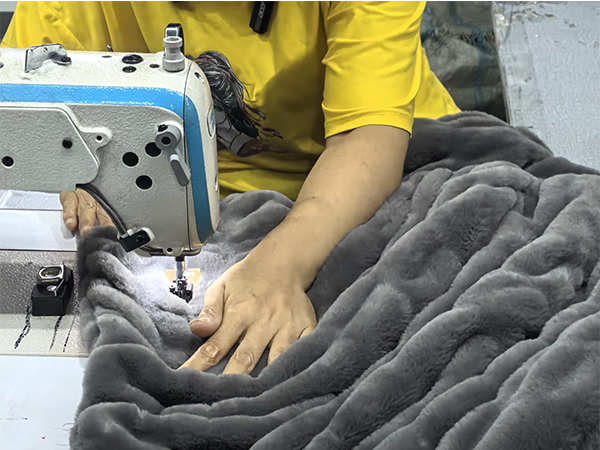
Shedding complaints must be carefully analyzed because they come from two completely different root causes:
Weaving Defects (Root Shedding): This occurs when the bottom pile yarns are not securely anchored into the base backing fabric during the weaving process. When this happens, the fibers pull out easily under light friction or washing. While it is technically impossible to achieve 100% shed-free performance under extreme manual pulling tests on a deep pile fabric, utilizing a standard 6-shuttle reinforced backing weave easily satisfies all normal consumer wear and laundering requirements.
Floating Fibers (Cutting Waste): This is not a true manufacturing defect or root shedding. Instead, it is simply residual loose fiber or dust generated when the fabric is cut and sewn. If the production line does not thoroughly vacuum and clean the finished blanket before packaging, these floating fibers will cling to the surface. When the end consumer opens the package or washes the blanket for the first time, they frequently mistake this loose waste for severe product shedding.
To protect global buyers from these manufacturing and supply chain risks, Ecozymat implements a strict, multi-layered quality assurance (QA) and quality control (QC) protocol across every stage of production:
Quantifiable Fabric Inspection Standards: We enforce clear, written fabric inspection metrics. Every production line supervisor and workshop worker is fully trained to know exactly what constitutes sub-standard fabric, ensuring that defective materials are rejected before they enter the cutting and sewing lines.
Early-Stage Bulk Audits: We inspect the fabric quality and texture of the very first batch of bulk production immediately. By identifying potential color vat differences or hand-feel deviations early in the timeline, we ensure on-time delivery and protect both parties from unexpected financial losses.
Mandatory Pre-Production (PPS) Approvals: For clients with high quality standards, we enforce a strict approval protocol. We require formal customer sign-offs on both pre-production samples and bulk fabric swatches before we authorize full-scale mass production.
6-Shuttle Weaving and Floating Fiber Removal: We exclusively use a 6-shuttle weaving process to minimize root shedding risks. In addition, we maintain strict cleanliness standards in our packing workshops. Every single finished blanket passes through a professional industrial vacuuming process to remove all cutting dust and floating fibers before final packaging.
Independent Secondary Quality Inspection: Our quality control inspectors operate completely independently of the production department. They answer directly to our quality management headquarters. This independent secondary inspection guarantees that every batch shipped to our international partners fully meets export-grade specifications.
We will contact you within 1 working day, please pay attention to the email with the suffix “@ecozymat.com”.