
Have you seen customer reviews like this?
“I wanted to like these cooling sheets. They do feel cool to the touch, but they made me overheat several times during the night.”
This is a common headache for B2B importers, Amazon sellers, and bedding brands. You source high-performance Nylon-Spandex cooling fabric, verify the initial thermal specs, and write accurate product details—yet end-users still leave 1-star reviews claiming the sheets “don’t stay cold.”
This issue is rarely a product defect. Instead, it stems from a gap between instant contact cooling and overnight continuous heat dissipation.
When end-consumers expect cooling bed sheets to replace air conditioning, negative reviews become almost inevitable.
Understanding how Nylon-Spandex cross-section fibers work—what they can do, and what they physical cannot do—helps brands manage buyer expectations, reduce return rates, and build cleaner product marketing.
Our cooling bed sheets, fitted sheets, and pillowcases use a high-ratio blend of Nylon (Polyamide) and Spandex, built with specially engineered cross-section nylon filaments.
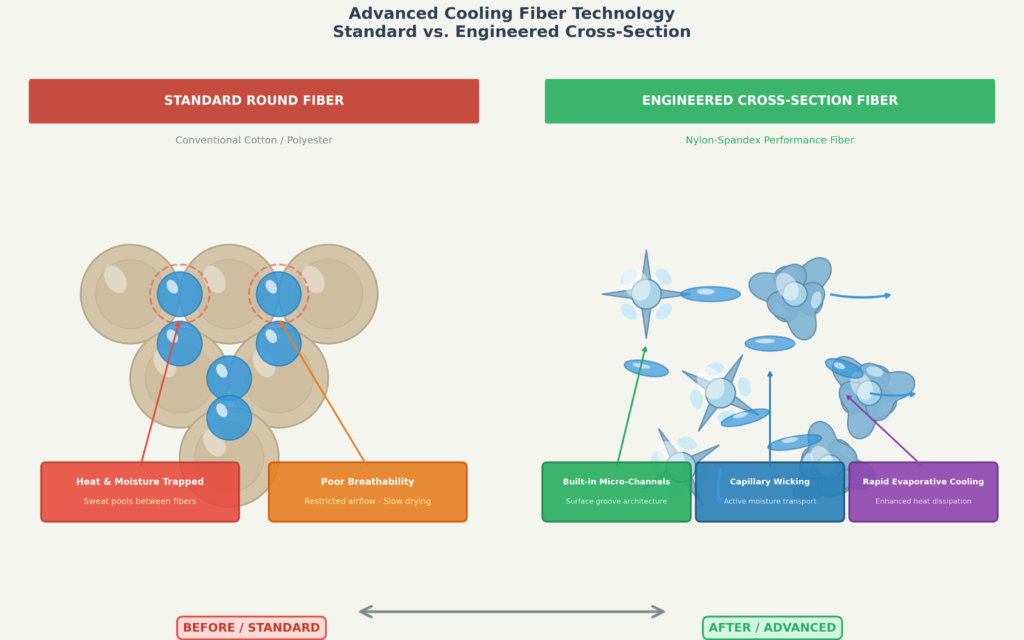
In standard sleeping conditions, this fiber technology provides two major advantages:
Instant Contact Cooling (High Q-Max)
Nylon naturally possesses high thermal conductivity and specific heat capacity. The moment skin touches the fabric, heat quickly transfers from the body to the sheet. This creates the instant “cool-to-the-touch” sensation mentioned in customer reviews.
Rapid Moisture Wicking (Capillary Action)
Traditional round-section fibers tend to trap moisture against the skin. In contrast, cross-section fibers (such as Y-shaped or cross-shaped profiles) feature microscopic grooves along the filament surfaces. Using capillary action, they draw sweat away from the body and spread it across a wider surface area to keep sleepers dry.
Bed sheets do not contain active refrigeration units like compressors or semiconductors. Fabric moves heat; it does not destroy heat.
When a sleeper stays in one position during the night, body heat (around 36.5°C / 97.7°F) transfers continuously into the fabric. Overheating happens when two physical limits are reached:
Barrier 1: Thermal Saturation
Every fabric has a limited heat capacity. In a hot room without AC or airflow (e.g., above 28°C / 82°F), the sheet absorbs body heat but has nowhere to release it. Within minutes, the fabric reaches thermal equilibrium with the body. Once there is no temperature gap between skin and sheet, contact cooling stops working.
Because high-performance cooling fabrics are woven densely for a smooth finish, they can trap ambient heat around the body if the room itself is hot and stagnant.
Barrier 2: Blocked Evaporative Cooling
Cross-section fibers move sweat fast, but moisture must evaporate to cool the body down. If the bedroom is humid and still, sweat stays trapped on the fabric surface. The natural evaporative cooling loop breaks, leading to a muggy, overheated feeling by 3 a.m.
Key Takeaway for B2B Buyers: Cooling sheets act as a thermal helper, not an AC unit. They need a climate-controlled environment (around 22°C–25°C / 72°F–77°F) to continuously dump body heat into the surrounding air.
For eCommerce sellers, sourcing managers, and private-label brands, avoiding these reviews relies on managing customer expectations before checkout.
Avoid Misleading Marketing Claims
Avoid: “Replaces Air Conditioning,” “Stays Ice-Cold All Night,” “Lowers Body Temp by 10 Degrees.”
Recommended: “Instant Cool-to-the-Touch,” “Advanced Sweat-Wicking for Hot Sleepers,” “Best Paired with Air Conditioning for Optimal Comfort.”
Add Clear Usage Guidelines on A+ Content / PDPs
Explicitly state on your product pages:
“Designed to enhance sleep quality in temperature-controlled environments (70°F–76°F). Works alongside AC or fans to continuously dissipate heat.”
Setting these expectations filters out buyers looking for an AC substitute while driving higher satisfaction among hot sleepers who use climate control.
No. The contact cooling comes from the intrinsic physical properties of Nylon fiber, and the moisture wicking comes from the permanent cross-section structure. Because no chemical topical finishes are used, the cooling effect will not wash out over standard laundry cycles.
High-tenacity nylon filaments can pill if exposed to heavy friction. We solve this during production by increasing yarn cohesion during spinning and applying a micro-crosslinking anti-pilling finish. Our finished fabric achieves a Grade 4 Anti-Pilling rating under ISO / GB standards, significantly cutting down post-sale complaints.
They are ideal for hot sleepers who sweat under regular cotton, people sleeping in AC rooms who want a cool surface without cold drafts, and buyers seeking silky, friction-free bedding.
Conclusion
A review saying “cool to the touch, but made me overheat” doesn’t mean your supplier delivered poor fabric. It means the end-user misunderstood how passive thermal management works.
By building clear product positioning and educating your market on material boundaries, B2B brands can protect their seller metrics, lower return rates, and build lasting customer loyalty.
We will contact you within 1 working day, please pay attention to the email with the suffix “@ecozymat.com”.